The safest, most effective therapies for optimal health!
THIS SITE IS AI FREE!
NO AI WAS USED IN THE CREATION OF ANY ARTICLE OR IMAGE
by Ellen Landauer
Abdominal Exercises to Lose Belly Fat
If you do abdominal exercises (including sit-ups) correctly, they will help you lose belly fat. Emphasizing alignment, suppleness, core strength and smoothness of movement increases the benefits.
One of the reasons for the recent popularity of the Pilates Method is the effectiveness of its abdominal exercises. Pilates emphasizes proper form.
A key hint is to 'think long' through your body as you are doing sit-ups (and for that matter, any exercise). This means to consciously imagine your whole body lengthening, rather than tightening and compressing, as you move.
Imagine that the top of your head is lengthening out of your shoulders and neck, and your ribcage is lifting away from your pelvis. Below, I show how to lengthen in preparation to doing a Pilates-style sit-up.
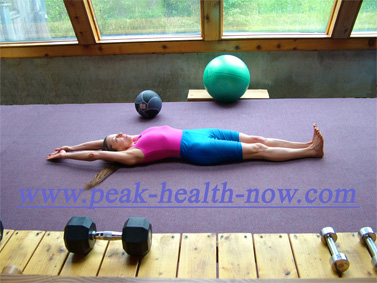
Abdominal Exercises Hints
Think long all the way from the top of your head through the bottom of your heels. This is a wonderful stretch in its own right. Done well, it feels really good.
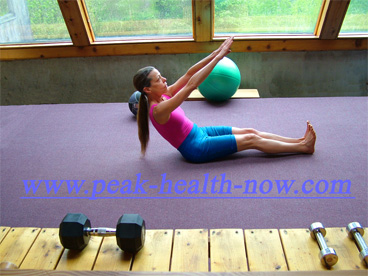
Photo below: This is the most challenging part of the exercise for maintaining body length and a flat belly.
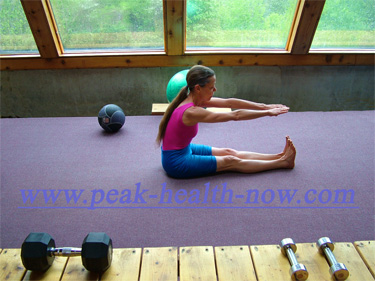
Once you are most of the way up, it becomes easier to allow the abdominals to fall back toward the spine gracefully.
Abdominal Exercises Variations:
Diagonal Movement
There are various ways you can achieve gracefully toned, properly functioning abdominals. Exercises like the one below tone the obliques as well as the rectus.
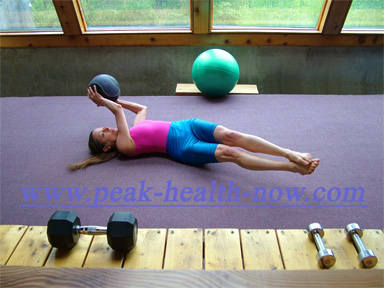
This one is done on a diagonal, with the weight of the medicine ball assisting in balancing the weight of the legs, first to one side then bringing the legs and arms up, centered over the belly before going to the opposite side. So the exercise takes the form of an 'X.'
Here is the most important thing you need to know: when doing abdominal exercise, keep your outermost belly muscles gently pulled back toward your spine.
Try not to do this in a rigid way. Rather, use the minimum muscle contraction to achieve it.
As you do the exercise, imagine that your torso is actually lengthening. That way, your rectus abdominis, obliques, transverse muscles and the deepest abdominal muscle - the psoas (which is actually a hip flexor), are all working together.
When you see people at the gym efforting to lift too much weight, and losing their good form, they are tightening, compressing, and contorting their bodies. They are shortening their bodies. A more compressed body will not carry weight as gracefully as a lengthened one. As well, paying attention to good form will help you avoid muscle strains and other injuries.
Ellen Landauer is an expert with over 40 years in-depth study and experience of the safe and effective use of nutritional supplements, botanical extracts and detoxification methods.
She is Certified as an Advanced Practitioner of Structural Integration body therapy developed by Dr. Ida P. Rolf - also known as Rolfing. This hands-on therapy is the deepest, most comprehensive body alignment therapy.
Ellen Landauer is also a PUBLISHED AUTHOR!
To learn more about Ellen Landauer, see her detailed bio HERE
The Food and Drug Administration has not evaluated any of the statements on this website. Products offered on this website are not intended to diagnose, treat, cure, or prevent any disease. The information presented on this site is provided for informational purposes only; it is not meant to be a substitute for medical advice or diagnosis provided by your physician or other medical professional. If you have any health problem, please consult with a physician or health care provider before using any natural products. Peak Health Now and/or its product suppliers assume no liability for any injury, illness or adverse affects caused by the misuse and/or use of the information or products presented on this website.
© 2008 - 2026 ™Peak Health Now.com. All rights reserved.
Throughout this website, statements are made pertaining to the properties and/or functions of food and/or nutritional products. These statements have not been evaluated by the FDA and these materials and products are not intended to diagnose, treat, cure or prevent any disease. For all health and medical questions, please consult with your doctor. By viewing this site, you are stating that you agree with this disclaimer.
BRAND NEW!
REAL NAD!
**PHONE ORDERS**
413-339-8527
IMPORTANT NOTE: This line is for orders ONLY! Please determine product selection before calling.
Please go to CONTACT PAGE for any questions you may have about the products.
We do NOT return international calls.
No solicitations, PLEASE!
FIND YOUR PRODUCTS:
Convenient listings for INFO and PURCHASE.
NOTE: Shipping fee is added for each product you put in cart.
**If too much shipping cost shows up on your order, we ALWAYS give prompt refund so you don't overpay!**
There is a modest $5.00 handling fee.
Shipping/Handling on all suppository products is FREE.
Bio-Identical
Transdermal
Creams for
Men and Women

Full-Spectrum Amino Acids,
Vitamins,
Minerals
Support Packages!
MONTIFF Amino Acids, Vitamins/Minerals:
The freshest products from a company of rare integrity!
Full-Spectrum Packages
to support health and healing!
NEW!
Tongkat Ali 100:1
Extract pure
powder

NEW!
Robuvit® Oak
Wood Extract
powder

Relieve chronic fatigue, boost energy, enhance sports performance, support cardiovascular and detoxification!
Full-Spectrum Amino Acids,
Vitamins,
Minerals
Support Packages!
MONTIFF Amino Acids, Vitamins/Minerals:
The freshest products from a company of rare integrity!
Full-Spectrum Packages
to support health and healing!